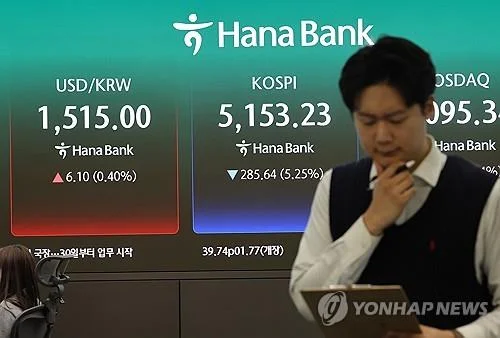
South Korean Stocks Plunge Amid Middle East Conflict and Oil Supply Fears
South Korea's stock market sharply declined Monday as rising hostilities in the Middle East fueled investor anxiety over global oil supplies. The KOSPI index dropped 216.2 points, or 3.98 percent, trading at 5,222.67 by late morning. Heavy foreign selling compounded the downward pressure, reflecting growing uncertainty in global markets. The conflict stems from US-Israeli strikes on Iran and recent missile attacks by Yemen's Houthi rebels on Israel, signaling a further escalation in the region. These developments sparked concerns over potential disruptions to critical energy supplies, pushing oil prices higher and unsettling global markets reliant on steady crude deliveries. This turmoil... [Continue Reading]
 360LiveNews | 30 Mar 2026 03:57

South Korean Stocks Plunge as Middle East Conflict Spurs Global Market Turmoil
South Korea’s benchmark KOSPI index fell sharply by 4.43% in early trading after Iran-backed Houthi militants in Yemen launched missile strikes on Israel. This marked the Houthis' first military action since the conflict began last month with U.S.-Israeli strikes on Iran. Their involvement signals a worrying escalation in the Middle East war, raising fears of a wider regional conflict. The spike in tensions has caused global oil prices to climb amid concerns over potential disruptions to supply lines. South Korean markets reacted swiftly to the risk, reflecting investor anxiety about stability in the energy sector and geopolitical risks that could... [Continue Reading]
360LiveNews | 30 Mar 2026 02:33


Global oil prices surge as US-Israel coalition conflict with Iran escalates, Brent crude exceeds $115 a barrel
As the conflict between the US-Israel coalition and Iran escalates, global oil prices have surged, marking significant market shifts. On Monday, Brent crude oil prices climbed over 3% to exceed $115 a barrel, while US-traded oil reached $103, reflecting a 3.5% increase. This increase positions Brent on course for its largest monthly gain on record, indicating growing concern about the geopolitical implications of the ongoing hostilities. The rise in oil prices coincides with stock market declines in Asia, where the Nikkei 225 index in Japan saw a reduction of 4.5%, and the Kospi in South Korea fell by 4%. Financial... [Continue Reading]