President Meloni Addresses Maritime Navigation and Security in Strait of Hormuz Conference
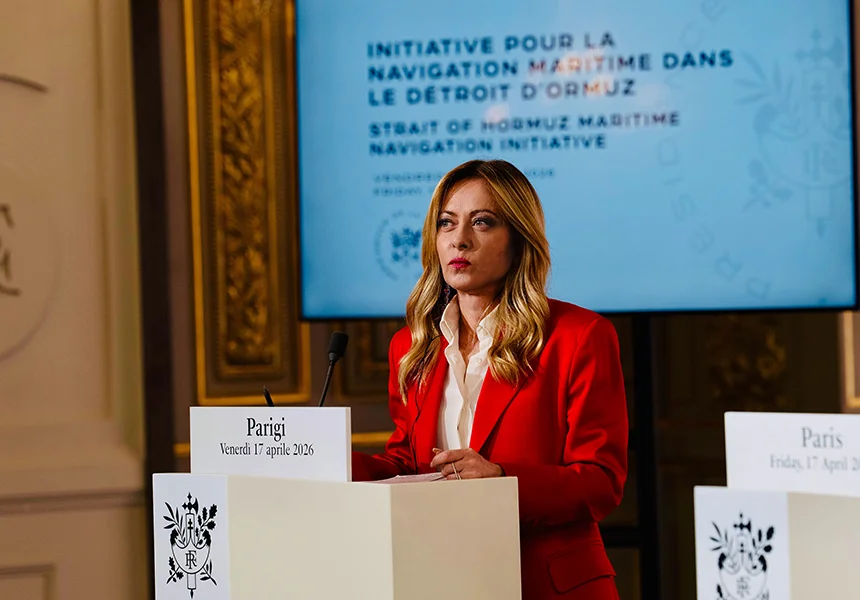
My thanks, of course, to President Macron and Prime Minister Starmer for this initiative. I consider this initiative to be extremely important, which is why I wanted to be here in person.
Freedom of navigation in the Strait of Hormuz is clearly an absolutely central issue for our nations , for Italy, for Europe, and for the international community as a whole. This is obviously about affirming a cornerstone principle of international law , a principle that applies to Hormuz and to any other passage on which global supply chains depend.
However, it is obviously also a huge economic issue: as we know, approximately 20% of global oil and liquefied natural gas consumption passes through Hormuz. Fertilizers are often talked about, which is another fundamental issue on which the food security of millions of people depends, especially in the most fragile contexts.
I am also thinking of imports into the Gulf nations, which are strategic partners of Italy and Europe, and which see 60% of their food consumption pass through Hormuz. It is therefore easy to understand that reopening Hormuz means addressing these critical issues, but also means building an essential element of any solution to the Middle East conflict.
This has been clearly seen over the last few hours: the key importance of the issue of reopening Hormuz to the negotiation process has been particularly clear, considering the developments over the last hours; as President Macron recalled, in response to the ceasefire in Lebanon, the passage of ships through the Strait has been reopened, at least on the Iranian side, for the duration of the ceasefire that has been negotiated between the United States, Iran and Israel. The reopening of Hormuz therefore forms part of any serious negotiation plan for the Middle East crisis.
Although it clearly isn't the only one , we know that the issue of Iran's renunciation of the nuclear arms race and the building of a security architecture in which no nation is threatened will be the other fundamental elements for the future , it is the reason why we are here today. We all understand the scale of this challenge.
I wish to thank Keir and Emmanuel as well as the many nations, representing very different contexts, that participated in today's meeting. This demonstrates that the work we are doing is not driven by a partisan interest, but is rather driven by a general interest.
Our objective requires efforts across different areas: diplomatic, security-related, and also humanitarian , think of the seafarers stranded in the Gulf, and the nations directly impacted by the crisis. Italy is ready to do its part in all these areas.
Obviously, everyone's attention is focused above all on the naval presence in Hormuz. This is crucial for several reasons: for concrete needs, such as demining the stretch of sea around Hormuz and, more generally , as has been mentioned , to reassure the maritime industry and provide a security framework for ships transiting the Strait.
It is clear, however, that an international naval presence in Hormuz can only be initiated once hostilities have ceased, in coordination with all regional and international actors, and with an exclusively defensive posture.
