Defence Minister Chan Chun Sing Highlights Technology's Role in ASEAN Security at 8th Putrajaya Forum
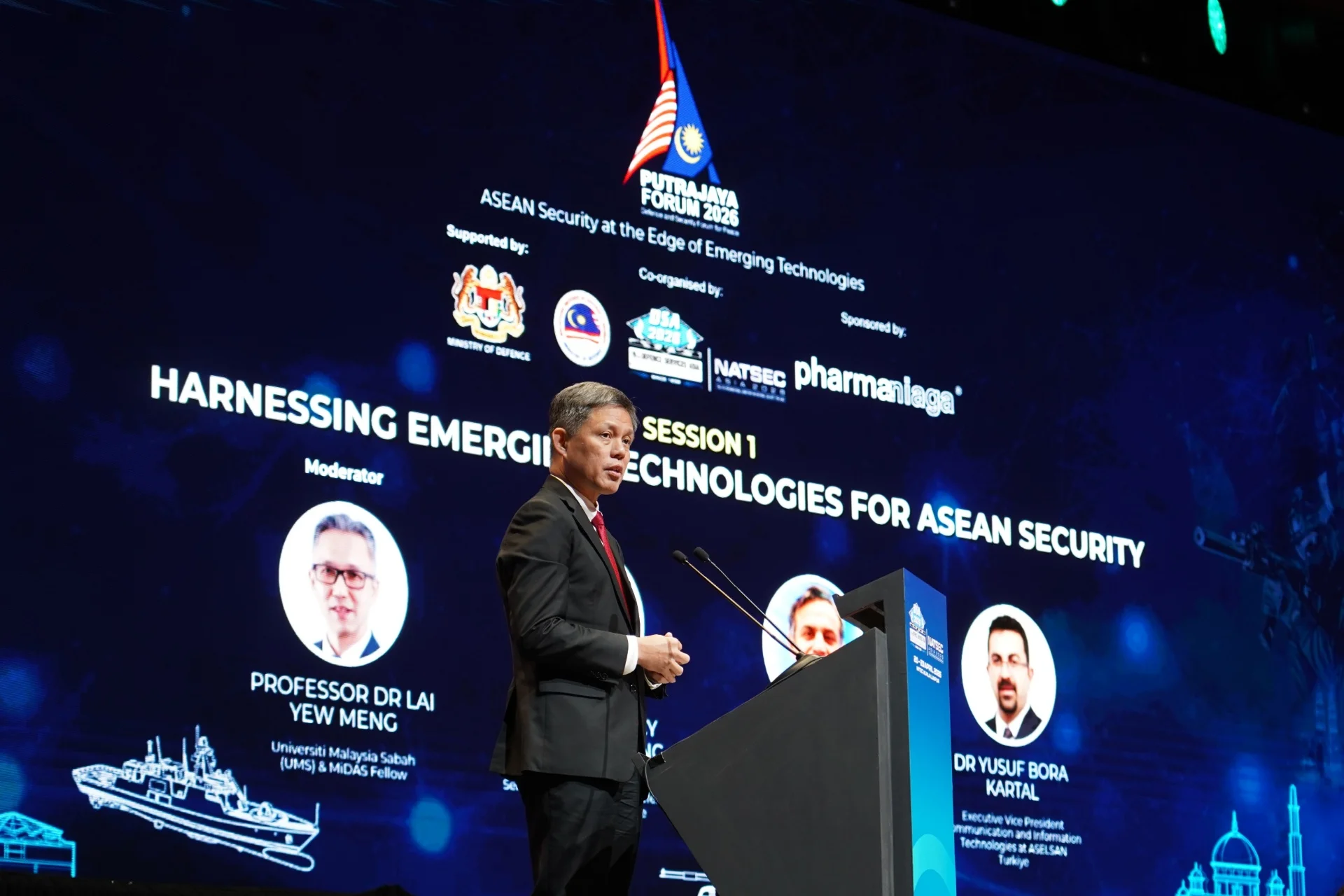
Distinguished guests, ladies and gentlemen, a very good morning to all of you. Let me first thank Malaysia for this discussion and for advancing ASEAN's conversation on emerging technologies and security.
Emerging technologies are often discussed in abstract, but recent developments, including that in the Straits of Hormuz, remind us that technology must have real-world purpose, such as keeping international airspace and waters open, safe and efficient. The ongoing Middle East conflict has renewed attention on these vital air spaces and waterways.
For Southeast Asia, this is not a remote or distant issue. Our region sits at the crossroads of global trade.
Impeding transit results in far- and fast-rippling effects through supply chains, energy markets and the cost of living for our people. The littoral states of the Malacca Straits depend on trade for our survival and success.
We share a common interest in keeping it open, safe and efficient. The right of transit passage through straits used for international navigation, like the Malacca Straits, is well established under international law - the United Nations Convention on the Law of the Seas (UNCLOS).
It is a continuing right, not subject to suspension nor dependent on prior permission or fees. As the volume of traffic grows with economic development, our shared challenge is to allow the increasing volume of traffic to do so safely and efficiently.
But littoral states may also have concerns about who is passing through and their intent, given the significant air and maritime traffic near them. Left unaddressed, these questions can lead to suspicion and misunderstanding.
We have to balance transit rights with safety and security. This is where technology can and has made a difference.
It moves us from uncertainty to visibility, from assumptions to evidence. It creates a shared and trusted picture of reality.
It helps manage the growing movement through our ports and airways. This enhances information sharing and safety for all users.
In the past, tracking of ships and planes relied on radar and sporadic reports, leaving gaps, especially over open seas. Today, systems like the Automatic Dependent Surveillance-Broadcast, or ADS-B, and the Automatic Identification System, or AIS, leverage satellite navigation and onboard transmitters.
They continuously broadcast the position, movement and identity of vessels. Planes can now be tracked in real time globally, while ships can see one another beyond the horizon, bringing clarity to even the busiest air and sea lanes.
These systems highlight a simple truth: transparency builds trust, which sustains openness. Safety and efficiency are better managed without unnecessary debate over sovereignty, which is never in doubt, nor the key issue in play.
How to do so efficiently and safely is our primary concern. New technologies let us go further to see and better manage the growing volume of traffic through our region.
Digital twins can now model airspace and maritime environments to optimise traffic flows. Unmanned Aircraft System Traffic Management, or UTM systems, will enable safe management of manned and unmanned traffic in an increasingly congested airspace.
We must also strengthen the resilience of our systems.
#PutrajayaForum #MalaccaStraits #UNCLOS #AutomaticDependentSurveillanceBroadcast #UnmannedAircraftSystemTrafficManagement
