GAS, GOD, AND GUNS: The Secret Agenda Behind the Washington Talks and the Death of the Maritime Border

The mahogany tables of the U.S. State Department are hosting a ghost today. As official delegations from Israel and Lebanon convene for a third round of high-stakes negotiations this Friday, May 8, 2026, the air in Washington is thick with the scent of a "peace" that looks increasingly like a strategic ambush. While the world watches the diplomatic theatre, the reality on the ground in Southern Lebanon tells a story of a predatory recalibration. Prime Minister Netanyahu isn’t just looking for a ceasefire; he is aiming to hit three birds with one single, devastating stone: the annexation of land, the erasure of Hezbollah, and the absolute seizure of Mediterranean energy wealth.

Sponsored
For the first time since the 1983 failure, the Lebanese government, now under the desperate stewardship of President Joseph Aoun, finds itself in a room with its greatest adversary. The "Trump Ceasefire," mediated with the unlikely help of Pakistan, was supposed to silence the guns by April 17. Yet, the guns have only changed their rhythm. The current military landscape has entered a surreal "dual-track" phase where diplomats sip coffee in D.C. while the IDF enforces what Finance Minister Bezalel Smotrich has explicitly called the "new Israeli border" at the Litani River.
This "Yellow Line" is the first bird in Netanyahu’s sights. By demanding a buffer zone up to the Litani, Israel is effectively fulfilling a long-held far-right religious dream of territorial expansion. The "Operation Eternal Darkness" aerial blitz of early April was no mere counter-terror operation; it was a demographic clearing. With over 2,700 Lebanese dead and 1.6 million displaced, the IDF is physically carving out a new frontier, daring the international community to call it anything other than a "security necessity."
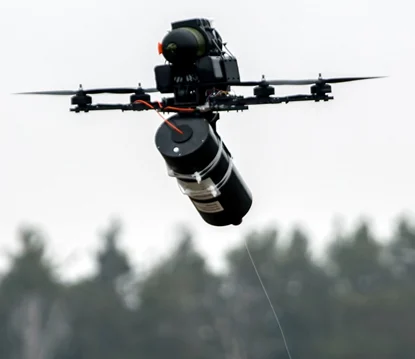 The second bird is the neutralization of Hezbollah, but the stone is hitting a wall of fibre-optic glass. Despite the diplomatic pressure, the battlefield has shifted into a lethal hide-and-seek. Hezbollah’s deployment of fibre-optic FPV drones, immune to electronic jamming and virtually undetected until impact, has turned the southern hills into a graveyard for Israeli armor. These "combat nodes" have forced the IDF to pause its deep invasion, leading to a calculated shift in Washington. If Israel cannot win the ground through sheer force, it will use these talks to legislate Hezbollah out of existence, demanding their total disarmament as a prerequisite for the very survival of the Lebanese state.
The third and perhaps most lucrative bird is the "Qana Capture." In March, Israeli Energy Minister Eli Cohen unceremoniously labelled the 2022 maritime border agreement a "document of surrender." Today, that deal is essentially dead. By establishing the "Yellow Line" as the new de facto border, Israel is repositioning itself to seize the massive Qana gas reserves in the Mediterranean. This isn't just about ideology; it is a resource-first foreign policy. By controlling these waters, Israel secures energy dominance over the eastern Mediterranean, effectively turning Lebanon into a landlocked energy vassal.
The geopolitical stage is further complicated by the "Hormuz Variable." Just yesterday, May 7, the U.S. and Iran exchanged fire in the Strait of Hormuz, a "love tap" that has sent tremors through the Washington talks. While President Trump insists the ceasefire holds, the tension in the Gulf proves that the Lebanon front is merely one theatre in a much larger, more volatile drama. The exchange of missiles near Qeshm Island serves as a grim reminder that any deal signed in Washington is only as strong as the next drone launch in the Persian Gulf.
Naim Qassem, the embattled leader of Hezbollah, has called these talks a "ploy," and for once, his rhetoric may align with the cold strategic reality. Lebanon enters these negotiations from a position of near-total collapse, its sovereignty already shredded by an invasion that has advanced 10 kilometres deep into its heart. The Lebanese delegation, led by Simon Karam, is fighting for a ceasefire that expires on May 17, while the Israeli delegation, led by Ron Dermer, is playing for the map of the next century.
What we are witnessing is the "Great Reset" of the Levant. The Israeli strategy is a masterclass in opportunistic diplomacy: use the cover of a U.S.-mediated peace process to legitimize territorial gains, dismantle a military rival through legislative ultimatum, and secure the keys to the region’s energy future. The "three birds" are already in the air; the only question left is whether Lebanon has any stones left to throw.
As the sun sets over the Potomac today, the delegates will likely emerge with "constructive" platitudes. But back in the smoking ruins of Tyre and Bint Jbeil, the people know better. They know that when the powerful talk of peace in Washington, the maps are usually being redrawn in blood.
THE RELIGIOUS RUIN: THE EROSION OF THE MORAL HIGH GROUND

Sponsored
The strategic objectives in Washington are being further complicated by a series of disturbing reports from the frontlines that are shifting the global moral compass. While the IDF frames its push into Southern Lebanon as a tactical necessity, the physical reality in multi-religious villages like Yaroun, Qozah, and Debel tells a different story. Reports have emerged of the systematic demolition of ancient monasteries and historic churches, some dating back centuries. The viral footage of soldiers desecrating icons of the Virgin Mary and statues of saints has sparked a firestorm of international outrage, drawing uncomfortable parallels to the iconoclastic rampages of ISIS in Iraq and Syria. For the Christian communities of Lebanon, who have historically maintained a delicate neutrality, these are not the actions of a "defence force" but of a campaign fuelled by a broader, more radical intolerance.
This cultural and religious erasure is fundamentally altering the narrative of the war. As entire villages, heritage-rich clusters of stone and history, are levelled to the ground, the argument of "surgical strikes" loses its teeth. To many international observers, the scorched-earth policy suggests that the objective isn't merely to push back a militia, but to render the land uninhabitable and its history forgotten. This perceived "war of hate" has inadvertently handed Hezbollah a potent psychological weapon. By positioning themselves as the last line of defence for the very soil being erased, the group has gained a newfound momentum. In the eyes of many across the Global South and even within sceptical European circles, the "terrorist" label is being eclipsed by the "resistance" mantle. The argument is simple: when a nation’s history, faith, and homes are being systematically liquidated, the right to defend one’s land becomes a universal principle, regardless of the banner under which that defence is mounted.
Till I write again,
This is Anthony Sterling, signing off…