Fear the Shia, Arm the Sunnis: The Uncomfortable Numbers Behind America’s War Narrative

“When fear is managed carefully enough, a nation can be taught to look away from the blood on the floor and stare instead at the shadow on the wall.”

Sponsored
A friend of mine, whose name I will not reveal because he asked me not to, sat across from me over dinner and placed a question on the table that would not leave me alone. He was born into a Muslim Shia background, and for the angle of this article, that detail matters, not because I wish to reduce a man to a sect, but because sect has become one of the most abused weapons in the modern political vocabulary.
He looked at me and said, almost as a dare, “Dig it out. Find out whether Iran-Shia ever carried out one of the major terrorist attacks on American soil.”
The sentence abused my journalist mind. I had never framed the question that way, I had heard the slogans for decades, Iran is the danger, Iran is the fanatic state, Iran is the spider at the center of every web, Iran is the Islamic monster beneath America’s bed. But I had never truly asked, with the cold cruelty of numbers, where the blood on American soil actually came from.
I asked him if he would allow me to include him in the article. He refused. Then he reminded me of an Arabic saying, translated roughly as, “If you were not killed yet, you should at least learn from those who did!”
His caution was not theatrical. He reminded me of Sir Salman Rushdie, born into a Kashmiri Muslim family, whose novel The Satanic Verses turned him into a target for extremists and forced him into years of protection after Iran’s Ayatollah Khomeini issued a fatwa calling for his death. Decades later, in August 2022, Rushdie was stabbed on stage in New York. U.S. prosecutors later charged Hadi Matar, a Lebanese-American from New Jersey, with terrorism offenses related to the attempted murder, alleging support linked to Hezbollah. The details matter, because they show that Iran-linked violence and threats exist, but they also show why categories must be used carefully. Rushdie was an assassination target, not part of the nine major completed domestic mass-casualty jihadist attacks on American soil examined below.
That distinction is the spine of this article. Iran is not innocent. No state in that region is truly innocent. But journalism does not exist to repeat slogans. It exists to separate heat from light, accusation from evidence, and propaganda from pattern.
The Dinner Question That Would Not Let Me Sleep
I could not sleep that night. The question kept walking around the room, knocking on old assumptions. If America has been taught for decades to see Shia Iran as the central Islamic threat, what does the domestic record of major jihadist attacks actually say?

Sponsored
So, I began with the major attacks on U.S. soil since 1976. Not every crime, not every plot, not every failed conspiracy, not every lone act of political violence, but the major completed attacks that shaped the American imagination, killed or wounded civilians, shocked the country, or forced national security to rewrite itself.
“Numbers do not care about slogans. They do not kneel before alliances. They do not salute flags. They simply stand there and accuse whoever needs to be accused.”
The result dazzled and disturbed me. Of the sixteen major terrorist attacks on American soil in the last half-century that we used as the working dataset, roughly nine were linked to jihadist ideology, al-Qaeda, ISIS, AQAP, or self-radicalized actors speaking in the language of global jihad. Within that major domestic jihadist set, I did not find a Shia Iranian pattern. I found something else.
I found al-Qaeda. I found ISIS. I found AQAP. I found self-radicalized men invoking Sunni jihadist doctrine. I found Saudis, Pakistanis, Emiratis, Chechen or North Caucasus origins, an Egyptian, a Lebanese, an Uzbek, and American-born men from Palestinian, Afghan, Pakistani, or converted backgrounds. But among these major completed domestic jihadist attacks, I did not find Iran.
Numbers Do Not Lie
The following table focuses only on the nine jihadist-related major attacks on American soil in the working list. It does not include non-jihadist domestic terrorism, far-right violence, anti-government violence, or unsolved attacks. It also does not classify ordinary military retaliation by a state as “terrorism,” because that is a separate legal and political category.
|
Year |
Attack |
Casualties |
Direct attacker(s) |
Origin / nationality |
Religion / sectarian ideology |
|
1993 |
World Trade Center bombing |
6 killed, more than 1,000 injured |
Ramzi Yousef and conspirators |
Main planner Pakistani citizen, born in Kuwait |
Muslim, Sunni jihadist / al-Qaeda-linked milieu |
|
2001 |
2,977 victims killed, excluding 19 hijackers, thousands injured |
19 al-Qaeda hijackers |
15 Saudi, 2 UAE, 1 Egyptian, 1 Lebanese |
Muslim, al-Qaeda, Sunni jihadist ideology |
|
|
2009 |
13 killed, more than 30 wounded |
Nidal Malik Hasan |
U.S.-born, Palestinian family origin |
Muslim, violent jihadist radicalization context |
|
|
2013 |
3 killed, hundreds injured |
Tamerlan and Dzhokhar Tsarnaev |
Chechen / North Caucasus origin |
Muslim, self-radicalized jihadist ideology |
|
|
2015 |
San Bernardino attack |
14 killed, 22 wounded |
Syed Rizwan Farook and Tashfeen Malik |
Farook U.S.-born Pakistani origin, Malik Pakistani national |
Muslim, ISIS-inspired terrorism |
|
2016 |
Pulse nightclub shooting |
49 killed, 58 wounded |
Omar Mateen |
U.S.-born, Afghan family origin |
Muslim, pledged allegiance to ISIS, no proven ISIS operational command |
|
2017 |
New York City truck attack |
8 killed, about 12 injured |
Sayfullo Saipov |
Uzbekistan-born |
Muslim, ISIS-inspired |
|
2019 |
Pensacola naval base shooting |
3 killed, 8 wounded |
Mohammed Saeed Alshamrani |
Saudi national |
Muslim, AQAP / al-Qaeda-linked jihadist ideology |
|
2025 |
New Orleans Bourbon Street truck attack |
14 killed, around 30 or more injured |
Shamsud-Din Jabbar |
U.S.-born American from Texas, Muslim convert |
Muslim convert, ISIS-inspired, FBI said he acted alone |
Nationality and Origin Count in the Nine-Attack Dataset
Counting the simplified list of roughly twenty-nine principal or direct attackers across the nine major jihadist-related domestic attacks, the nationality and origin pattern is measurable. The Saudi figure dominates because fifteen of the nineteen September 11 hijackers were Saudi nationals, and the Pensacola attacker was also Saudi.
|
Nationality / origin |
Approx. number of direct attackers |
Where they appear |
|
Saudi Arabia |
16 |
15 hijackers on 9/11, plus Pensacola naval base attacker |
|
Pakistan / Pakistani origin |
3 |
Ramzi Yousef, Syed Rizwan Farook, Tashfeen Malik |
|
United Arab Emirates |
2 |
Two 9/11 hijackers |
|
Chechen / North Caucasus origin |
2 |
Boston Marathon bombers |
|
Egypt |
1 |
Mohamed Atta, 9/11 |
|
1 |
Ziad Jarrah, 9/11 |
|
|
Palestinian family origin |
1 |
Nidal Hasan, Fort Hood |
|
Afghan family origin |
1 |
Omar Mateen, Pulse nightclub |
|
Uzbekistan |
1 |
Sayfullo Saipov, New York truck attack |
|
American-born convert |
1 |
Shamsud-Din Jabbar, New Orleans |
Of the sixteen major terrorist attacks on American soil in the last half-century, roughly nine were linked to jihadist ideology, al-Qaeda, ISIS, AQAP, or self-radicalized actors speaking in the language of global jihad. The national origins were not uniform, but the pattern is measurable. Among roughly twenty-nine direct attackers in this working dataset, sixteen were Saudi, three were Pakistani or of Pakistani origin, two came from the United Arab Emirates, two from the Chechen or North Caucasus world, and one each from Egypt, Lebanon, Uzbekistan, Palestinian family origin, Afghan family origin, and one American-born convert.
The sectarian line, where it can be identified, points not to Islam as a faith, but to the hard machinery of Sunni jihadist extremism, especially al-Qaeda, AQAP, ISIS, and their ideological descendants. These are movements that transformed religion into a weapon, grievance into doctrine, and civilians into targets. This distinction matters, because without it, truth becomes propaganda, and analysis becomes collective accusation.
The Weapons Pipeline and the Manufactured Fear of Iran
So, the question writes itself, and it refuses to leave the room.
If the threat is always sold to the American public as Iranian and Shia, why has the American weapons pipeline flowed so heavily toward the Sunni monarchies and Sunni-majority allies surrounding it?
First, they told us the danger was Iran blocking the Strait of Hormuz, the narrow maritime artery through which a major share of the world’s oil and gas lifeblood passes.
Before that, they told us the danger was Iran’s nuclear program, enriched uranium, breakout time, centrifuges, inspectors, and the old familiar vocabulary of apocalypse. Washington’s argument has repeatedly treated Iran’s enrichment as the center of the region’s nuclear danger, while Iran has argued that sanctions, sabotage, threats, and military pressure have turned diplomacy into a theatre of coercion.

Sponsored
The Nuclear Silence Around Israel
But here comes the nuclear silence nobody in Washington wants to touch.
Iran is a party to the Nuclear Non-Proliferation Treaty, which means its declared nuclear program exists under the vocabulary of inspections, safeguards, reports, violations, accusations, negotiations, and threats. Israel, by contrast, is widely understood to be the only nuclear-armed state in the Middle East, yet it has never formally declared its nuclear arsenal, has never joined the NPT, and has maintained a policy of nuclear ambiguity for decades. AP reported that Israel is widely believed to possess between roughly 80 and 200 nuclear warheads, while neither confirming nor denying the arsenal. The Arms Control Center likewise notes that Israel is not a party to the NPT and has not accepted IAEA safeguards over some principal nuclear activities.
This is not a small technicality. It is the entire double standard placed under a microscope. Iran is inspected, sanctioned, accused, threatened, and forced into negotiations over enrichment. Israel is shielded by opacity. The IAEA’s own description of the NPT safeguards system makes clear that non-nuclear weapon states that join the treaty accept safeguards to verify that nuclear material is not diverted to weapons. Israel has chosen to remain outside that framework.
The 1995 NPT Review and Extension Conference called for an effectively verifiable Middle East zone free of weapons of mass destruction. Qatar’s Foreign Ministry called in 2025 for all Israeli nuclear facilities to be placed under IAEA safeguards and for Israel to join the NPT as a non-nuclear state. Yet the demand disappears whenever Israel is the state under discussion.
“Is the problem nuclear danger, or nuclear danger in the hands of the wrong country?”
If Iran’s secrecy is a threat to civilization, then what should we call Israel’s opacity? Strategy? Deterrence? Western comfort? Or simply the privilege of being the exception written into the empire’s private dictionary?
Hamas, Qatar, and the Convenient Geography of Blame
Before that, they told us Iran wanted to attack Israel. Then came the most politically convenient irony of all, the October 7 Hamas attack was folded into the argument for confronting Iran. But Hamas is not Shia. Hamas is a Sunni Islamist movement. The Council on Foreign Relations describes Hamas as an Islamist militant movement, and the October 7 attack was led by Hamas from Gaza. Israel and its allies may link Hamas to Iranian funding, weapons, or regional strategy, but sectarian identity still matters when the argument being sold to the world is that Shia Iran is the primary Islamic danger.
Let us be clear, because clarity is the last honest weapon left in a world drowning in slogans. I do not defend the bloody path Hamas chose. I do not romanticize civilians being killed. I do not excuse kidnapping. But even when I reject the method, I must still examine the political claim behind it. Hamas presents itself to Palestinians as resistance against occupation, and the word “occupation” is not an invention of Arab emotion. The International Court of Justice’s 2024 advisory opinion dealt directly with Israel’s occupation of Palestinian territory, and UN Security Council Resolution 2334 reaffirmed that Israeli settlements in Palestinian territory occupied since 1967, including East Jerusalem, have no legal validity.
So, if Hamas is Sunni, if the attacks on American soil were overwhelmingly tied to Sunni jihadist currents, and if Iran has not carried out one of the major completed domestic jihadist attacks on American soil in the record we examined, why does the American public keep be told that the ultimate Islamic danger is Shia Iran?
The Irony Becomes Even Thicker When We Remember Qatar
On 9 September 2025, Israel struck Hamas leaders in Doha, the capital of Qatar, while they were reportedly involved in ceasefire-related discussions. The strike killed several Hamas members and one Qatari security officer, and Qatar condemned it as a violation of its sovereignty. Reports said Israel used air-launched weapons that Qatari air defenses did not detect in time.
Sponsored
This is where the question becomes brutal!
Only months earlier, on 23 June 2025, Iran fired missiles at Al Udeid Air Base in Qatar after U.S. strikes on Iranian nuclear sites. Qatar said its air defenses intercepted the incoming missiles, and no casualties were reported.
So, when Iran fired, the shield worked, or at least it was allowed to work. But when Israel fired, the shield saw nothing, fired nothing, stopped nothing!
That is the whole scandal in one sentence.
Qatar had spent billions on Western air-defense systems. It had spoken proudly about its ability to defend its skies. Yet when Israel struck Doha, the explanation became technical, the weapons were not detected, the trajectory was difficult, the warning was late, the system was not designed for that kind of threat. Perhaps all of that is true. But politically, the message was devastating.
The Gulf does not merely buy weapons. It buys conditional protection.
Protection from Iran, yes.
Protection from Israel, no.
And that is the quiet humiliation behind the billion-dollar shield, Arab states may own the hardware, but they do not fully own the sky.
Qatar itself sits in another uncomfortable corner of the story. For years, U.S. officials and congressional sources have raised concerns about private financing networks in the Gulf that benefited jihadist groups in Syria and Iraq. That must be written carefully, because allegations about private donors and sanctioned individuals are not the same as proving official state policy. But the record of U.S. designations and congressional concern exists, and it complicates the clean story Washington sells to its citizens.
The Al-Jawlani Paradox
Then comes the al-Jawlani paradox.
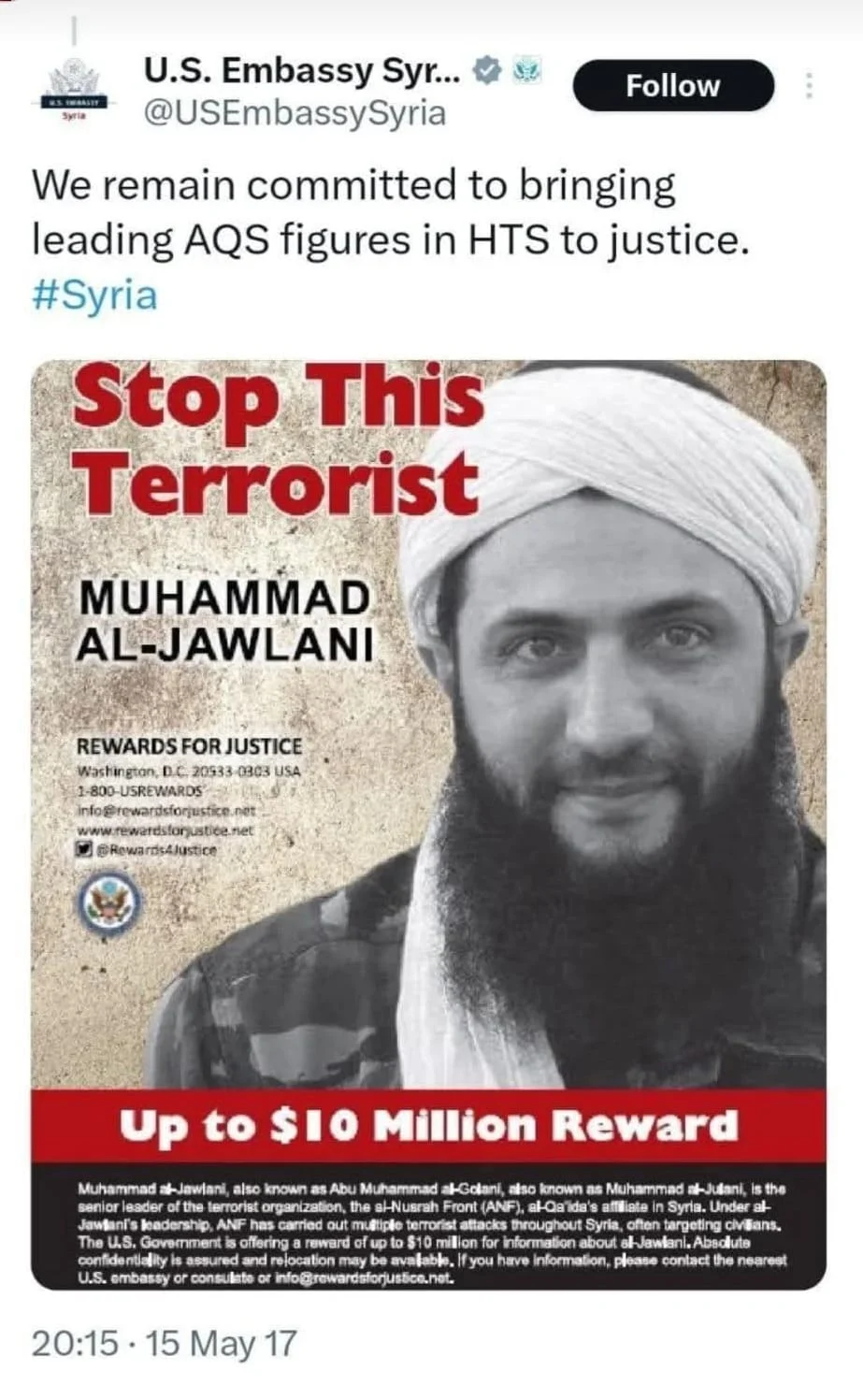
The man once known as Muhammad al-Jawlani, later Ahmad al-Sharaa, had a U.S. State Department Rewards for Justice bounty of up to $10 million on his head as leader of al-Nusrah Front, al-Qaeda’s affiliate in Syria. The State Department said al-Nusrah was the Syrian branch of al-Qaeda and that al-Jawlani pledged allegiance to al-Qaeda leader Ayman al-Zawahiri in 2013.
Sponsored
image: U.S. Rewards for Justice style bounty announcement for Muhammad al-Jawlani. Included as visual context for the article’s later discussion of al-Jawlani / al-Sharaa.
Then history changed its costume.
In December 2024, the United States dropped the $10 million reward after U.S. diplomats met him in Damascus, with AP reporting that he pledged to renounce terrorism. In 2025, President Trump met Ahmad al-Sharaa after announcing sanctions relief for Syria, a stunning reversal for a former al-Qaeda-linked militant who had spent years under the language of terrorism and bounty posters.
“Are we watching another useful extremist being cleaned, suited, photographed, and reintroduced as a statesman because the map now requires him?”
Are we creating another ghost that our children will one day be asked to fear? Another bin Laden manufactured by expediency, tolerated by strategy, then condemned after the fire has spread? Only time will tell, and history is not famous for forgiving those who refused to read its warnings.
Numbers Do Not Only Count Weapons, They Expose Relationships
The United States did not build its Middle Eastern security architecture by arming Iran after 1979. It built it by arming Iran’s Sunni-majority rivals, partners, and neighbors.
Saudi Arabia received the language of modern air power, F-15SA fighters, Patriot missiles, THAAD missile defense, sustainment packages, radar, missiles, and the invisible infrastructure of permanent military dependency. Qatar received F-15QA fighters, Patriot air defenses, Apache helicopters, and later approval for MQ-9B armed drones. The UAE was offered one of the most sensitive packages ever placed on the table for an Arab state, up to 50 F-35 stealth fighters, 18 MQ-9B drones, and advanced munitions. Bahrain received the F-16V path. Kuwait was approved for Super Hornets. Jordan received F-16 Block 70 aircraft. Egypt has been armed for decades with American aircraft, tanks, missiles, helicopters, and sustainment. And when we turn toward the Shia-majority world, the great silence begins.
Iran, the central Shia power in the region, has received no major U.S. arms sales since the 1979 Islamic Revolution. The only major Shia-majority exception is Iraq after 2003, but Iraq’s case belongs to a different category, because those sales came after the American invasion, occupation, reconstruction, and later the war against ISIS. Iraq received F-16s, air-defense systems, and Abrams tanks, not because Washington suddenly trusted Shia power, but because Washington was managing the consequences of its own war and the collapse it helped create.
|
Recipient |
Sectarian / political category |
Major U.S. weapons or systems |
Approx. value |
|
Saudi Arabia |
Sunni-majority monarchy |
F-15SA fighters and F-15S upgrades |
About $29.4B |
|
Saudi Arabia |
Sunni-majority monarchy |
Patriot PAC-3 MSE missiles approved in 2026 |
About $9B |
|
Saudi Arabia |
Sunni-majority monarchy |
F-15 sustainment and support approved in 2026 |
About $3B |
|
Qatar |
Sunni-majority monarchy |
F-15QA aircraft, weapons, support, equipment, training |
About $21.1B approved |
|
Qatar |
Sunni-majority monarchy |
MQ-9B armed drones, bombs, missiles, satellite-control equipment |
Nearly $2B initial approval |
|
UAE |
Sunni-majority federation |
Up to 50 F-35s, 18 MQ-9B drones, munitions |
About $23.37B |
|
Kuwait |
Sunni-majority monarchy |
F/A-18E/F Super Hornets, support, training, weapons integration |
About $10.1B |
|
Bahrain |
Sunni-ruled monarchy, Shia-majority population |
F-16V fighters and F-16 upgrades |
About $3.86B |
|
Jordan |
Sunni-majority monarchy |
F-16 Block 70 fighters, engines, weapons, support |
About $4.21B |
|
Egypt |
Sunni-majority state |
F-16s, Apache helicopters, Abrams tanks, missiles, sustainment |
Billions over decades |
|
Iran after 1979 |
Shia-majority Islamic Republic |
No normal major U.S. arms pipeline, sanctions and restrictions instead |
None in modern Islamic Republic era |
|
Iraq after 2003 |
Shia-majority state |
F-16IQ aircraft, Abrams tanks, air defense, sustainment |
Billions, tied to U.S. occupation, reconstruction, and anti-ISIS policy |
The table says what speeches try to hide. The fear has been sold in one direction, while the weapons have flowed in another. This is not an accidental pattern. This is architecture.
When Retaliation Becomes a Label
Now we arrive at the dangerous question: If Israel and the United States attack Iran, and Iran responds by attacking Israeli or American military interests within its reach, is that automatically “Shia terrorism”?
This is not a defense of Iran. It is a defense of language. In international law, the word terrorism is contested, especially when state military forces are involved in armed conflict. The International Committee of the Red Cross has warned that counterterrorism discourse can blur the lines between armed conflict and terrorism. So, if Iran deliberately targets civilians, that can be criminal, immoral, and potentially a war crime. But if Iran attacks military bases in response to a state attack, that may be escalation, retaliation, or armed conflict. Calling every Iranian response “Shia terrorism” is not analysis. It is propaganda wearing a legal costume.
A state can be aggressive. A state can be brutal. A state can violate international law. But if every Iranian response is automatically called terrorism while every Israeli or American strike is called security, then we are no longer discussing law. We are discussing privilege.
Sponsored
Southern Lebanon and the Moral Collapse of the Security Slogan
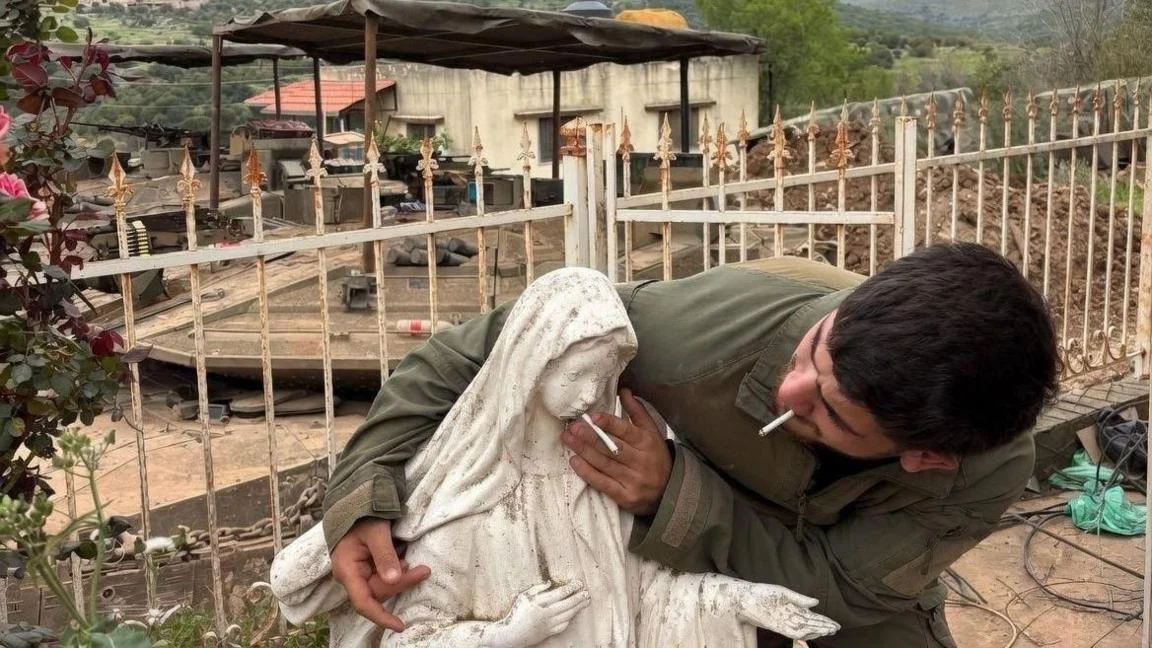 This is why southern Lebanon matters to this article.
The Israeli army says it is acting for security. Yet reports from southern Lebanon now include Christian symbols desecrated by Israeli soldiers and villages scarred by the logic of buffer zones and military necessity. AP reported that two Israeli soldiers were sentenced to military prison after one placed a cigarette in the mouth of a statue of the Virgin Mary in southern Lebanon and another photographed it but, what about the hundreds of other incidents that were not photographed but the aftermath destruction that appeared later witness it clearly. This followed an earlier incident involving soldiers damaging a statue of Jesus in a southern Lebanese village.
The desecration of Christian symbols in southern Lebanon echoes a wider pattern of Christian anxiety under Israeli power and settler extremism. AP reported in 2023 that Israeli police arrested suspects after videos showed ultra-Orthodox Jews spitting near Christian pilgrims and churches in Jerusalem. In 2026, a French Catholic nun and archaeological researcher was attacked near Jerusalem’s Old City, with police arresting a 36-year-old suspect. Vatican News reported the arrest and identified the victim as a French-born religious sister working with the French School of Biblical and Archaeological Research in Jerusalem.
Then came Palm Sunday. AP reported that in 2026 Israeli police prevented Catholic leaders from entering the Church of the Holy Sepulchre to celebrate a private Palm Sunday Mass, the first such restriction in centuries, citing wartime security concerns during the Iran war. The Latin Patriarchate called the decision disproportionate, while the United States and several European governments criticized the restriction.
Sponsored
So, when Netanyahu scolds Ben-Gvir over the humiliation of detained flotilla activists and says the conduct was not in line with Israel’s values and norms, the question almost tears itself out of the page.
What norms? The norms of settlers who spit near churches? The norms of extremists who assault nuns? The norms of barring or restricting Christian leaders from ancient Palm Sunday rites that survived empires, caliphates, crusades, mandates, occupations, and wars? The norms of a state whose officials condemn the image after the damage is done, while the machinery that produced the damage keeps moving?
And Christians are not alone in this pressure. Palestinians in the West Bank face the daily arithmetic of settlement expansion, raids, demolitions, forced displacement, and settler violence. The UN Human Rights Office reported in 2026 that Israeli settlement expansion and annexation policies had driven mass displacement in the West Bank. OCHA reported settler violence during the olive harvest reaching high levels, with attacks, injuries, and thousands of trees and saplings vandalized. AP has reported cases of settlers entering Palestinian homes, damaging property, harming livestock, and frightening families from their communities.
So again, we return to language. If a Shia militia had spat at Christians outside churches, assaulted a nun, restricted Palm Sunday, entered Palestinian homes, damaged property, destroyed villages, or mocked sacred Christian symbols, the vocabulary would already be loaded, printed, televised, and repeated until the world memorized it. Extremism. Sectarian terror. Religious hatred. Barbarism.
But when the violence comes from the side protected by American power, the words are softened until they lose their teeth. Misconduct. Security. Tension. Investigation. Regrettable incident.
“This is how hypocrisy survives, not by hiding the crime, but by changing the name of the crime.”
The Mediterranean Incident and the Theater of Humiliation
Then came Itamar Ben-Gvir and the flotilla.
In May 2026, Israeli forces intercepted a Gaza-bound flotilla carrying hundreds of international activists. AP reported that Ben-Gvir released videos taunting detained activists after they were brought to Ashdod, and that Netanyahu scolded him, saying the way he dealt with the activists was not in line with Israel’s values and norms. Al Jazeera reported that officials and critics around the world described the interception of Gaza-bound aid vessels as an “act of piracy,” while legal debates turn on whether the interception occurred in international waters and whether Israel’s blockade is lawful.
Again, I ask the question without apology. If a non-Western militia intercepted foreign civilians at sea, detained them, humiliated them on camera, and paraded them as political trophies, what word would the Western press use by breakfast? Would it be security? Or would it be terrorism?
The Fear of Those Who Never Touched the Soil
This is where my mind has been consumed, not by hatred, but by the exhaustion of watching truth twisted until it screams.
I was born Christian, but that has nothing to do with why I write this. I write this because I love cultures. I love argument. I love the strange beauty of sitting at a table with people from different religions, different sects, different ideologies, and still searching for the truth without needing to destroy one another.
That is why this question disturbs me so deeply.
Sponsored
How did President Trump, and the presidents before him, manage to persuade so many Americans that they should fear most the people who, according to the major domestic jihadist attack record we examined, never carried out those attacks on American soil?
Not the Saudi majority among the September 11 hijackers. Not the Sunni jihadist machinery of al-Qaeda, AQAP, ISIS, al-Nusrah, and their ideological descendants. Not the U.S. allies accused of tolerating extremist financiers. Not the weapons pipeline flowing toward Sunni-majority states around Iran. Not the occupation, humiliation, blockade, settlement expansion, and religious desecration that keep manufacturing rage faster than diplomats can manufacture slogans.
No, the great fear must always be Iran.
The Shia ghost.
The convenient enemy.
The country Americans are told to fear even when the bloodstains on American soil point somewhere else.
That does not make Iran innocent. No state in that region is truly innocent. And let me be clear, I condemn radicalism and jihadism whether it comes from Sunni extremists or Shia extremists, but what unsettles me most is the painful irony that these enemies, divided by more than 1,400 years of blood, doctrine, and rivalry, still have one thing in common, they read from the same book while some among them turn faith into a weapon.
But it does make the narrative suspicious. And when a narrative becomes this selective, when facts are rearranged to serve weapons sales, alliances, sanctions, and war, journalism has only one duty left, to pull the curtain back and ask why the magician keeps pointing our eyes away from his hands.
Till I write again,
This is Anthony Sterling signing off...
Sources and Direct Links
The source list below contains direct links for the factual claims, data tables, and incidents referenced in the article. The article uses these sources as background evidence and attribution points, not as endorsements of any government or media framing.
Section One, Domestic jihadist-related attacks and Salman Rushdie: 1993 World Trade Center bombing, FBI case history, September 11 investigation and hijacker nationalities, FBI, Fort Hood review and violent radicalization context, HSDL, Boston Marathon bombing, FBI case history, San Bernardino attack deemed terrorism, FBI, Pulse nightclub shooting, FBI case history, 2017 New York truck attack and ISIS connection, DOJ, Pensacola naval base shooting and AQAP connection, FBI, New Orleans Bourbon Street truck attack, AP report on FBI conclusion. Salman Rushdie biography and The Satanic Verses controversy, Britannica. Hadi Matar federal terrorism charges related to Rushdie attack, DOJ.
Section Two, Israel nuclear opacity, Hamas, occupation, and Qatar strike: Israel nuclear ambiguity and NPT status, AP. NPT and IAEA safeguards framework, IAEA. Middle East WMD-free zone history, IAEA. Israel nuclear profile, Center for Arms Control and Non-Proliferation. Qatar call to place Israeli nuclear facilities under IAEA safeguards. Hamas background and ideology, Council on Foreign Relations. October 7 Hamas attack, Britannica. ICJ advisory opinion on Israeli practices in occupied Palestinian territory. UN Security Council Resolution 2334 on settlements. UN experts condemn Israel strike in Qatar, OHCHR. Israel strike on Hamas chiefs in Qatar, Times of Israel. Al-Jawlani / al-Sharaa Rewards for Justice bounty on Muhammad al-Jawlani, U.S. State Department archive. U.S. drops $10 million reward after diplomatic meeting, AP. Trump meets Syrian President Ahmad al-Sharaa, TIME.
U.S. weapons pipeline and arms sales: Saudi F-15SA purchase and upgrades, U.S. Air Force. Saudi Patriot PAC-3 MSE missiles, DSCA. Qatar F-15QA aircraft, DSCA PDF. Qatar MQ-9B drone approval, AP. UAE F-35 / MQ-9 / munitions package, U.S. State Department archive. Bahrain F-16V package reporting. Kuwait Super Hornet package, DSCA PDF. Jordan F-16 Block 70 package, DSCA PDF. Iran sanctions framework, U.S. State Department.
Sponsored
Lebanon, Christians, settlers, Palm Sunday, flotilla, and legal language: Israeli troops sentenced over Virgin Mary statue desecration, AP. Attack on French nun in Jerusalem, Guardian. Arrest over attack on French nun, Vatican News. Palm Sunday Church of the Holy Sepulchre restriction, AP. West Bank settlement expansion and displacement, OHCHR. West Bank settler violence update, OCHA. Settlers enter Palestinian home and damage property, AP. Ben-Gvir taunting flotilla detainees, AP. Flotilla interception described by critics as piracy, Al Jazeera. Terrorism and international humanitarian law distinction, ICRC.