Breaking News: General Dan Caine provided the first comprehensive operational update since the launch of "Operation Epic Fury"
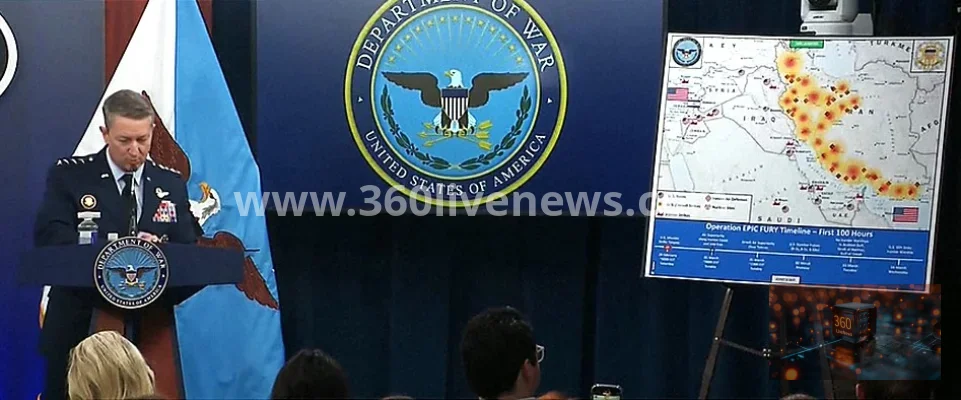
Executive Summary, The State of the Conflict
General Dan Caine, Chairman of the Joint Chiefs of Staff, confirmed that the United States has entered what he described as “major combat operations.”
Speaking at the Pentagon press briefing room, Caine emphasized that the campaign will not be short or limited.
“This is not a single overnight operation. The military objectives tasked to CENTCOM and the Joint Force will take time to achieve. In some cases, this will be difficult and gritty work.”
The remarks signal that U.S. leadership is preparing the public and allies for a sustained military campaign, potentially involving significant operational risk and extended deployments.
Maritime Strike, Iranian Frigate IRIS Dena Destroyed
One of the most significant developments confirmed during the briefing was the destruction of an Iranian naval warship.
According to Caine, U.S. forces sank the IRIS Dena (75), a Jamaran-class (Moudge-class) multi-purpose frigate.
The vessel was reportedly targeted and destroyed by a U.S. Navy Virginia-class fast-attack submarine.
The loss of the Dena represents a major blow to Iran’s naval capabilities, removing one of Tehran’s primary platforms for power projection in the Indian Ocean and the protection of maritime routes linked to global energy supply.
Cyber and Space Warfare, “First Movers” in the Operation
Caine revealed that the opening phase of the campaign relied heavily on non-kinetic warfare.
U.S. Cyber Command and U.S. Space Command conducted operations designed to disrupt and degrade Iranian surveillance and communications systems before the first physical strikes occurred.
This digital disruption effectively “blinded” Iranian command networks, allowing U.S. forces to deploy a coordinated air assault.
More than 100 aircraft launched from both land bases and naval platforms during the opening phase, enabling U.S. forces to establish localized air superiority within the first 57 hours of the operation.
Strategic Logistics and Force Deployment
The campaign has also required a massive logistical effort.
Caine confirmed that B-2 stealth bombers flew a 37-hour round-trip mission from the continental United States, striking deeply buried Iranian facilities.
Meanwhile, two major U.S. carrier strike groups, the USS Gerald R. Ford and USS Abraham Lincoln, were repositioned over the past month to strengthen the U.S. military posture in the region.
National Guard units have also been mobilized, including elements from the Wisconsin Army National Guard and Vermont Air National Guard, the latter deploying F-35 fighter aircraft.
Regional Allies and the Defensive Shield
While the United States and Israel are leading offensive operations, regional partners have played a critical role in defensive operations.
Air defense systems deployed across Qatar, the United Arab Emirates, Kuwait, Jordan, and Saudi Arabia have intercepted hundreds of Iranian ballistic missiles and attack drones, helping shield military installations and civilian infrastructure.
The coordinated defensive network highlights the scale of cooperation among U.S. partners across the Middle East.
Final Message From the Pentagon
Closing the briefing, General Caine delivered a stark message aimed at adversaries and allies alike.
“To those who would test our resolve, understand clearly, we can reach you. We can sustain the fight, and we can scale the fight.”
He also emphasized a shift in military posture away from the counterinsurgency wars of previous decades.
“We are not defenders anymore. We are warriors, trained to kill the enemy and break their will. Peace through strength, the warrior ethos, and unity of purpose are the beating heart of what it means to wear that uniform.”
