Trump rejects report on 9/11 appearance, signals lawsuit against NYT and Pulitzer body
President Donald Trump made multiple posts on Truth Social in the last hour: - "RT @realDonaldTrumpMaggot Hagerman, the Fake Reporter from The Failing New York Times, an unattractive person both inside and out, and who knows less about me than most reporters on the beat (She's a SCAMMER!), made up a story that on September 11th, I'm not going to the World Trade Center, in New York City, because they won't let me make a speech, and I'm going to the Pentagon in D. C., because I'm a featured speaker. This is more Corrupt News, I've been to New York... [Continue Reading]
 Breaking-360LiveNews | 28 Aug 2026 22:00 LONDON

Sponsored
Trump highlights falling goods and services deficit, says tariffs have not hurt exports
President Donald Trump posted on Truth Social at 28 August 2026 at 19:06 BST: "Laura Ingraham: "Year-to-date, the goods and services deficit decreased $189.3 billion, or 33.8 percent, from the same period in 2025. Exports increased $198.3 billion or 11.7 percent." "Imports increased $9.0 billion or 0.4 percent. Where are all the experts who claimed that the tariffs would kill our exports?" "GOOD NEWS TUESDAY...IN ADDITION TO THE DOW AND OIL DOWN....The trade deficit is going down, and exports are up for the year so far."" Explanation: President Donald Trump posted on Truth Social at 28 August 2026 at 19:06... [Continue Reading]
Breaking-360LiveNews | 28 Aug 2026 19:30 LONDON


US-Venezuela oil talks advance amid backlash over reported stake in major fields
Reports that the United States is in advanced talks to secure a direct stake or long-term access to Venezuelan oilfields have triggered sharp criticism from opposition figures and other detractors. The discussions are said to cover more than a dozen fields, including assets in the Orinoco Belt and Lake Maracaibo, two of the country's most important producing regions. The reported structure would go beyond a routine commercial arrangement and could give American interests a lasting role in one of the world's largest crude reserves.According to the supplied reports, one proposal under discussion is a 100-year lease on several oilfields, while... [Continue Reading]
360LiveNews | 28 Aug 2026 17:59 LONDON


Qatari PM heads to Tehran as mediation efforts continue over US-Iran talks
Qatar's prime minister is due in Tehran on Thursday for talks aimed at de-escalating tensions and reviving dialogue between Iran and the United States. The visit comes as the wider conflict has entered its sixth month without a diplomatic breakthrough. Qatar said the trip reflects its view that diplomacy remains the best way to resolve differences and support stability in the region.A spokesman for Qatar's Ministry of Foreign Affairs said Sheikh Mohammed bin Abdulrahman bin Jassim Al Thani will meet a number of Iranian officials. According to the statement, the discussions will focus on ways to reduce tensions and create... [Continue Reading]
360LiveNews | 27 Aug 2026 04:59 LONDON

Sponsored


Iceland holds knife-edge referendum on EU talks amid fish and sovereignty debate
Iceland is voting on whether to resume talks on joining the European Union in a referendum that polls suggest is too close to call. The vote has become a test of how the country balances economic concerns, sovereignty and its strategic position in the North Atlantic. In a nation of almost 400,000 people, the result could shape policy debates well beyond this weekend.The immediate issue is whether Iceland should reopen accession talks that were halted years ago. Prime Minister Kristrun Frostadottir's centre-left government pledged after winning a snap election in 2024 to hold a referendum by 2027, but recent geopolitical... [Continue Reading]
360LiveNews | 27 Aug 2026 00:30 LONDON
Day News Recap: Nepal flood toll rises as Haiti killings, Iran tensions and trade war deepen
Nepal’s flash floods and mudslides along the Nepal Tibet border have worsened, with at least 22 bodies recovered and 384 people still missing, after earlier reports said at least eight people had died in the disaster zone. 🔗 🔗In Haiti, the UN says at least 47 people were killed in a gang attack near Kenscoff, close to the capital Port au Prince, one of the deadliest recent assaults in the area. Survivors are still searching for missing relatives after armed men descended on the farming community and bodies were left in the streets. 🔗 🔗Iran remained at the centre of... [Continue Reading]
360LiveNews Recap | 26 Aug 2026 18:26 LONDON


US-Iran standoff deepens as Trump says he is not in a hurry for talks
United States President Donald Trump has said he has "no time schedule" for Iran to return to negotiations, sharpening the public standoff over the conflict between Washington and Tehran. In comments to Al Jazeera, Trump said he was "not in a hurry" and repeated that the United States was "winning very big." He also accused Iran of economic collapse and harsh treatment of protesters, while saying he would wait "whatever it takes" for talks to resume. The remarks came as the United States announced enhanced sanctions on Iran and 60 entities in other countries doing business with it.Officials have described... [Continue Reading]
360LiveNews | 26 Aug 2026 15:30 LONDON


Japanese lawmakers visit Beijing amid efforts to ease Taiwan-related rift with China
A delegation of Japanese lawmakers has travelled to Beijing this week in what observers say is an effort to ease one of the sharpest strains in Japan-China relations in decades. The visit comes after a diplomatic dispute triggered by remarks from Japan's Prime Minister Sanae Takaichi about Taiwan and the possible use of force in the event of an attack. The trip includes politicians from both the ruling and opposition camps, underlining the political sensitivity of the issue in Tokyo.Among those in the delegation is Gaku Hashimoto, a member of Japan's House of Representatives and a figure in Takaichi's ruling... [Continue Reading]
360LiveNews | 26 Aug 2026 12:05 LONDON

Sponsored


US expands sanctions pressure on Iran as secondary penalties are threatened
The United States has announced a new sanctions package against Iran and warned that countries and companies continuing to trade with Tehran could face secondary penalties. The measures were presented as part of a broader effort to cut off Iran's revenue streams and intensify economic pressure while the conflict remains unresolved. According to the supplied reporting, at least 60 entities across the Middle East, Asia and Europe have been targeted.US Treasury Secretary Scott Bessent said the campaign would focus on Iran's oil income and other sources of revenue, and that firms facilitating transactions linked to Iranian oil could be targeted.... [Continue Reading]
360LiveNews | 26 Aug 2026 08:59 LONDON
Breakfast News Recap: Haiti massacre, Hormuz tensions and trade war escalation dominate a busy global briefing
At least 47 people have been killed in a gang attack near Haiti’s capital, in Kenscoff, where survivors are still searching for missing relatives and bodies were left in the streets. The UN says the assault is one of the deadliest recent attacks in the area, and hostages are also being threatened. 🔗 🔗In Sudan, a medical network says 27 people, including four children, were killed in attacks in South Kordofan, the latest violence linked to the country’s wider conflict. The UN has also said Myanmar’s human rights situation has “plummeted to a new low”, warning that civilians continue to... [Continue Reading]
360LiveNews Recap | 26 Aug 2026 08:37 LONDON

Canada retaliates after new US tariffs deepen trade war
Canada has announced retaliatory tariffs of 15% to 50% on about US$20 billion worth of imports from the United States, escalating the trade dispute between the two countries. The measures are due to take effect on 8 September and will cover about 700 product types. Canadian officials said the move is a response to the latest wave of US tariffs after trade talks collapsed last week.Finance Minister Francois-Philippe Champagne said Canada was facing an unprecedented challenge and would meet the moment. The supplied reporting says the highest tariffs will apply to items including smartphones, cosmetics, milk, furniture and paper, while... [Continue Reading]
360LiveNews | 25 Aug 2026 21:59 LONDON


Taiwan indicts nine over alleged illegal exports of AI servers to China
Taiwanese prosecutors have charged nine people in Keelung over an alleged scheme to illegally export high-end artificial intelligence servers to mainland China. The case involves employees linked to Nvidia and Super Micro, and it has become the latest enforcement action in the wider contest over advanced computing hardware. Prosecutors said the servers were routed through multiple locations in an apparent attempt to evade export controls.According to the prosecutors, one Nvidia employee and two Super Micro employees are among those charged. They said 74 servers reached China, with 50 sent through Indonesia, 16 delivered directly and eight routed via Japan and... [Continue Reading]
360LiveNews | 25 Aug 2026 20:32 LONDON

Sponsored


Canada imposes counter-tariffs on more than 700 US products as trade talks collapse
Canada has announced retaliatory tariffs on US goods worth C$27.6bn, or $19.9bn, in response to new American duties and the collapse of trade talks with Washington. The measures will take effect on 8 September and will apply to more than 700 products, according to the Canadian government statement cited in the supplied material. The move marks a further escalation in the trade dispute between the two countries, which are each other's largest trading partners.The tariffs will range from 15% to 50% and will target sectors including steel, aluminium, dairy, appliances, agricultural equipment, pulp and paper, plastics and electronics. Canada also... [Continue Reading]
360LiveNews | 25 Aug 2026 19:03 LONDON


US removes Syria from state sponsor of terrorism list as investment barriers fall
The United States has removed Syria from its list of state sponsors of terrorism after 47 years, in a move Washington says clears the final major barriers to private sector investment and Syria's reintegration into the global economy. The decision also removes Hayat Tahrir al-Sham, or HTS, from the US list of global terrorist organisations. It marks another major shift in US policy toward Syria's new leadership.US Secretary of State Marco Rubio said the move reflected the Syrian government's positive actions to distance itself from acts of international terrorism. US Treasury Secretary Scott Bessent said the change would help foster... [Continue Reading]
360LiveNews | 25 Aug 2026 04:02 LONDON


US support for Iran war falls as Trump approval hits record low
Public support in the United States for military action against Iran has fallen to its lowest level since the conflict began, according to a Reuters/Ipsos poll released on Monday. The survey also found President Donald Trump's approval rating holding at 33%, matching the lowest level recorded in the polling series across both of his terms. The findings point to growing political pressure on the White House as the war continues and economic concerns deepen.The poll found that 31% of Americans surveyed support US military action against Iran, down from 37% in March and 34% earlier this month. Among Republican respondents,... [Continue Reading]
360LiveNews | 24 Aug 2026 23:04 LONDON


Nigeria sees gas opening as Iran war strains global markets
Nigeria says the war involving Iran has tightened global natural gas markets and created an opening for the country to expand its own production. The issue was set out by Ekperikpe Ekpo, Nigeria's minister of state for petroleum resources, who said the disruption could strengthen Nigeria's position as a major gas supplier. He pointed to plans linked to the Nigeria-Morocco gas pipeline and to wider efforts to attract investment.Ekpo said Nigeria wants to expand gas production and increase liquefied natural gas exports, with Europe identified as a key market. He also said the country is seeking to position its LNG... [Continue Reading]
360LiveNews | 23 Aug 2026 17:33 LONDON
Sponsored


Trump renews Strait of Hormuz claim as Iran threatens to keep waterway closed
Donald Trump has renewed his claim over the Strait of Hormuz after posting a map on Truth Social that depicted the strategic waterway as "new American territory". He did not comment on the image, but the post revived a dispute that has already drawn sharp responses from Iranian officials. The exchange centres on one of the world's most important shipping lanes and comes amid continuing tension between Washington and Tehran.The latest remarks were followed by a direct warning from Mohsen Rezaei, secretary of Iran's Supreme National Security Council, who said the strait would remain closed until the United States changes... [Continue Reading]
360LiveNews | 23 Aug 2026 15:29 LONDON


UN Security Council straw poll puts Guyana's Rodrigues Birkett ahead in race for next secretary-general
The United Nations Security Council has held a second informal straw poll in the race to choose the next secretary-general, with Guyana's Carolyn Rodrigues Birkett emerging as the leading candidate. The vote took place on Friday as the council continued its search for consensus ahead of Antonio Guterres' departure at the end of December. The poll is non-binding, but it is one of the main steps used to narrow the field before a formal recommendation is sent to the General Assembly.According to the results circulated after the vote, Rodrigues Birkett received eight votes to encourage, three to discourage and four... [Continue Reading]
360LiveNews | 22 Aug 2026 01:59 LONDON
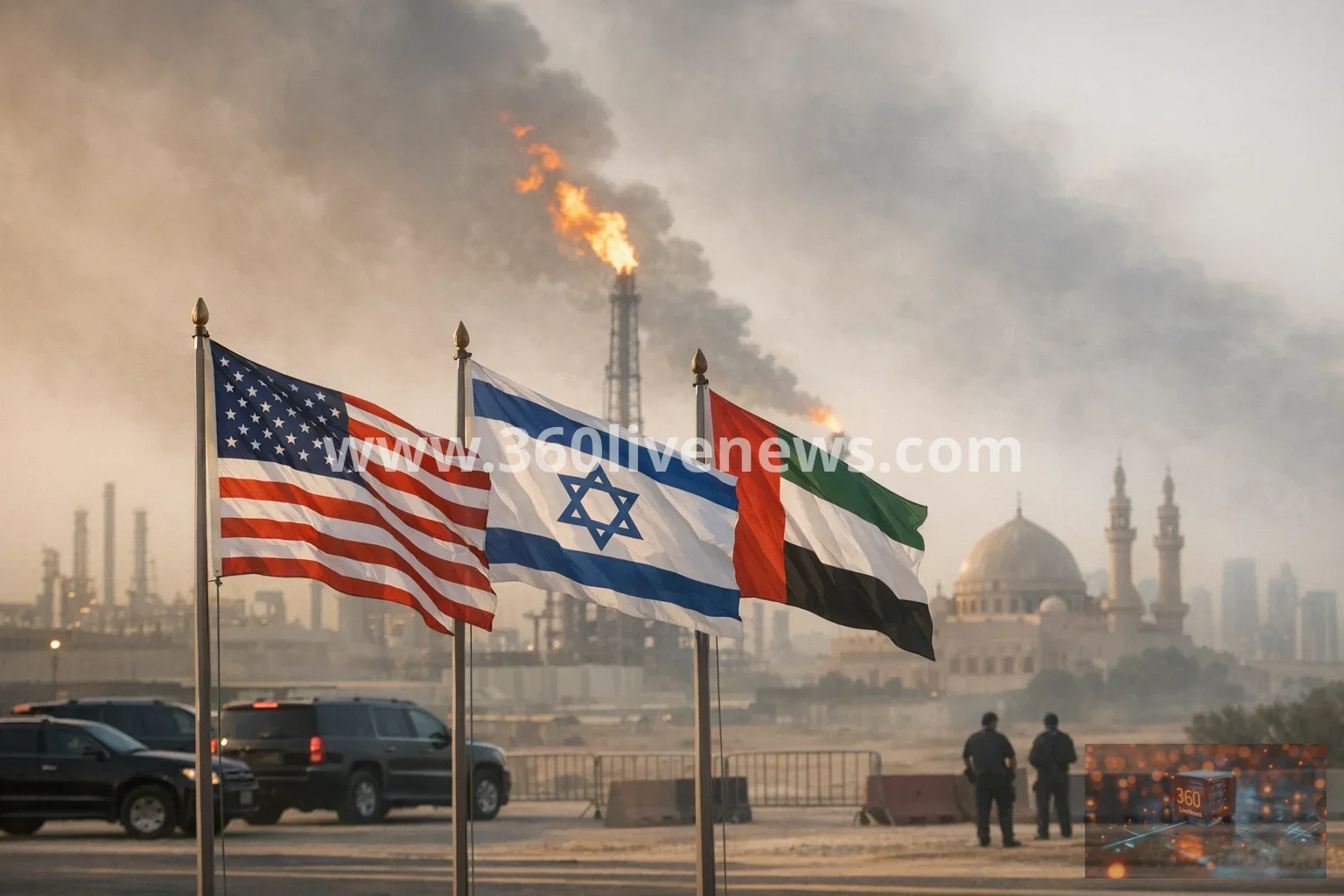
The Mirage of the Umbrella: The Shifting Sands of the U.S.-Israel-GCC Alliance
As I sat in a recent debate at the historic Carlton Club in London, listening to Faisal Abbas, the Editor-in-Chief of Arab News, I felt a tangible shift in the room, not because a new fact had been revealed, but because an old illusion had finally lost its last breath. The old-world order has not merely changed, it has evaporated, leaving the Gulf to realize it is no longer watching a distant fire from the safety of marble towers and air-conditioned ministries, but is instead standing directly inside the smoke. The GCC today is caught in a lethal crossfire between... [Continue Reading]
360LiveNews-Opinion | 29 Apr 2026 21:40 LONDON

Shadows of Fire: The Long Arc of Iran–United States Tensions
A Region on Edge: The Latest Escalation In recent months, tensions between Iran and the United States have intensified once again, fueled by disputes over regional security, nuclear development, maritime incidents in the Persian Gulf, and the broader strategic balance in the Middle East. Officials in Washington have expressed renewed concern over Iran’s uranium enrichment levels, while leaders in Tehran have accused the United States of economic warfare through sanctions and diplomatic isolation. The fragile equilibrium that followed earlier rounds of indirect negotiations appears increasingly strained, with both sides engaging in sharp rhetoric at the United Nations, reinforcing military postures... [Continue Reading]
360LiveNews-Opinion | 19 Feb 2026 08:49 LONDON
Sponsored